Overview
See Contents
- 1 Overview
- 2 What is Software as a Medical Device?
- 3 Why Software as a Medical Device Is Growing Rapidly
- 4 Software as a Medical Device vs Embedded Medical Device Software
- 5 How Artificial Intelligence Is Transforming Software as a Medical Device
- 6 Regulatory Framework for Software as a Medical Device
- 7 Core Components of Modern Software as a Medical Device
- 8 How to Develop Software as a Medical Device
- 9 How to Create Software as a Medical Device Successfully
- 10 How to Build a Software as a Medical Device for AI-Driven Healthcare
- 11 AI Best Practices for Software as a Medical Device
- 12 Common Challenges
- 13 Cost of Software as a Medical Device Development
- 14 Why Hire Engineers for Software as a Medical Device
- 15 Future of Software as a Medical Device
- 16 Conclusion
Healthcare is undergoing a digital transformation where software is becoming as critical as traditional medical devices. From AI-powered diagnostic platforms to remote patient monitoring applications, Software as a Medical Device is changing how clinicians diagnose, monitor, and treat patients. Unlike conventional medical equipment, these software solutions deliver clinical functionality without being tied to dedicated hardware, making innovation faster and more scalable.
The market reflects this momentum. According to Grand View Research, the global Software as a Medical Device market was valued at USD 1.81 billion in 2024 and is expected to grow at a compound annual growth rate (CAGR) of over 10% through the next decade. Meanwhile, Precedence Research estimates the broader AI in healthcare market will surpass USD 180 billion by 2034, highlighting how artificial intelligence is becoming a core capability within medical software. These trends show that healthcare organizations are investing heavily in intelligent digital products that improve patient outcomes while reducing operational costs.
Artificial intelligence is accelerating this evolution by enabling predictive analytics, automated diagnostics, personalized treatment recommendations, and continuous patient monitoring. However, developing clinical software requires much more than coding expertise. Regulatory compliance, cybersecurity, quality management, risk analysis, validation, and clinical evidence are equally important.
This complete guide explains everything organizations need to know about Software as a Medical Device, from regulatory requirements and AI integration to architecture, development, costs, and best practices
What is Software as a Medical Device?
Software as a Medical Device (SaMD) refers to software intended for one or more medical purposes that performs these functions without being part of a physical medical device. The International Medical Device Regulators Forum (IMDRF) introduced this definition to create a common global framework for regulating medical software.
Unlike firmware embedded inside MRI scanners or infusion pumps, Software as a Medical Device operates independently on cloud platforms, smartphones, tablets, desktops, or web applications.
Examples include:
- AI-powered medical imaging software
- Clinical decision support systems
- Remote patient monitoring platforms
- ECG interpretation software
- Diabetes management applications
- Digital therapeutics
- Mental health applications
- Ophthalmology screening solutions
- Cardiac risk prediction software
As healthcare becomes increasingly digital, organizations continue to develop Software as a Medical Device that improves accessibility while reducing dependency on specialized hardware.
Why Software as a Medical Device Is Growing Rapidly
Healthcare providers face increasing pressure to deliver better patient outcomes with fewer resources. Traditional medical devices often require expensive hardware, lengthy deployment cycles, and significant maintenance. Software-based medical solutions overcome many of these limitations.
Modern Software as a Medical Device enables healthcare organizations to deliver clinical intelligence through cloud platforms, mobile applications, and AI-powered analytics. Hospitals can deploy updates remotely, integrate with existing health information systems, and continuously improve performance through software releases.
Several factors are driving adoption:
- Rising chronic disease burden
- Growth of telehealth
- Increased use of wearable devices
- Expansion of remote patient monitoring
- AI-driven diagnostics
- Cloud healthcare infrastructure
- Regulatory support for digital health innovation
Healthcare organizations increasingly prefer software-first approaches because they shorten innovation cycles while improving scalability.
Software as a Medical Device vs Embedded Medical Device Software
Although these terms are often confused, they represent different categories.
Embedded medical software exists inside a hardware medical device and cannot function independently. Examples include software controlling ventilators, infusion pumps, ultrasound systems, or MRI scanners.
In contrast, Software as a Medical Device performs its medical purpose independently of dedicated hardware. It can process patient data, analyze medical images, recommend treatments, or monitor chronic conditions without controlling a physical medical device.
Understanding this distinction is essential because regulatory pathways and risk classifications may differ significantly.

How Artificial Intelligence Is Transforming Software as a Medical Device
Artificial intelligence has become one of the most influential technologies in digital healthcare. Today’s Software as a Medical Device increasingly incorporates machine learning, deep learning, natural language processing, and computer vision.
AI enables software to:
- Detect diseases from medical images
- Predict patient deterioration
- Analyze ECG signals
- Interpret pathology slides
- Automate radiology workflows
- Personalize treatment recommendations
- Identify medication risks
- Monitor chronic diseases
- Support preventive care
Rather than replacing clinicians, AI augments clinical decision-making by providing faster insights and reducing repetitive tasks.
Generative AI is also becoming valuable within Software as a Medical Device. Large language models assist physicians by summarizing patient histories, generating clinical documentation, identifying missing information, and supporting evidence-based decision-making while maintaining human oversight.
Future AI-enabled SaMD platforms will increasingly combine predictive analytics, multimodal clinical data, and continuous learning models to improve healthcare delivery.
Regulatory Framework for Software as a Medical Device
Building medical software requires strict adherence to international regulations. Compliance begins during product planning rather than after development.
Major regulatory frameworks include:
FDA (United States)
The U.S. Food and Drug Administration regulates many categories of Software as a Medical Device based on intended use and clinical risk. Developers may require 510(k), De Novo, or Premarket Approval depending on the product.
IMDRF
The International Medical Device Regulators Forum provides globally accepted guidance for defining and classifying Software as a Medical Device.
European MDR
The European Medical Device Regulation establishes safety and performance requirements for software marketed across Europe.
IEC 62304
This international standard defines software lifecycle processes, including planning, architecture, verification, validation, maintenance, and risk management.
ISO 13485
ISO 13485 specifies quality management system requirements for medical device manufacturers.
ISO 14971
This standard governs medical device risk management throughout the entire product lifecycle.
Additional compliance requirements often include:
- HIPAA
- GDPR
- SOC 2
- ISO 27001
- FDA Cybersecurity Guidance
Successful regulatory approval depends on integrating compliance throughout the entire development of Software as a Medical Device rather than treating it as a final step.
Core Components of Modern Software as a Medical Device
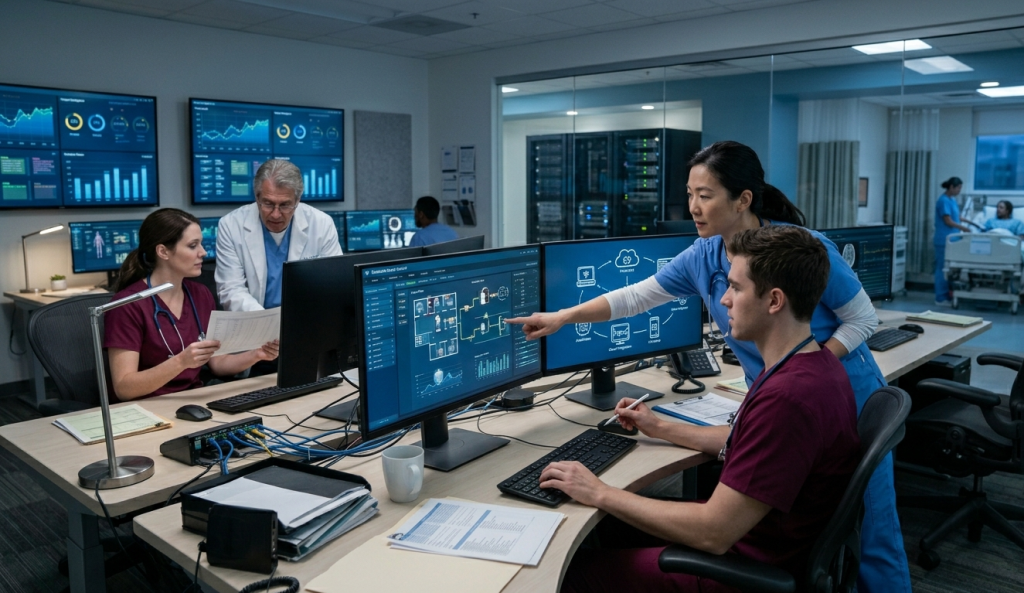
Today’s platforms combine multiple technologies into a secure healthcare ecosystem.
Typical architecture includes:
- Patient applications
- Clinician dashboard
- Cloud infrastructure
- AI inference engine
- Electronic Health Record integration
- HL7 and FHIR interoperability
- Authentication services
- Audit logging
- Data encryption
- Monitoring and analytics
- Device integration layer
- Clinical reporting engine
Scalable cloud-native architectures allow organizations to continuously improve Software as a Medical Device while maintaining regulatory compliance.
How to Develop Software as a Medical Device
Organizations looking to develop Software as a Medical Device should follow a structured lifecycle rather than a conventional software development process.
Clinical Discovery
Development begins by identifying the clinical problem, target users, intended use, regulatory classification, and measurable patient outcomes.
Risk Assessment
Risk management identifies potential hazards, software failures, cybersecurity threats, and clinical risks before development begins.
Product Design
UX designers collaborate with clinicians to create interfaces that minimize errors while supporting efficient clinical workflows.
Software Development
Engineering teams build secure, scalable applications using modern technologies, APIs, cloud infrastructure, and interoperability standards.
AI Model Development
Machine learning engineers prepare datasets, train models, validate algorithms, measure bias, and document model performance.
Verification and Validation
Extensive testing confirms that every feature performs as intended while meeting regulatory requirements.
Clinical Evaluation
Many products require clinical evidence demonstrating safety, effectiveness, and measurable healthcare benefits.
Regulatory Documentation
Teams prepare technical documentation, risk files, software architecture, validation reports, cybersecurity assessments, and quality records.
Following this structured process significantly improves the success of the development of Software as a Medical Device.
How to Create Software as a Medical Device Successfully
Organizations seeking to create Software as a Medical Device should avoid treating it as a traditional SaaS application.
Success depends on integrating multiple disciplines including:
- Clinical expertise
- Regulatory affairs
- Quality assurance
- Cybersecurity
- Artificial intelligence
- Software engineering
- DevOps
- Cloud architecture
- Data science
- Human factors engineering
Cross-functional collaboration reduces development risks while accelerating regulatory approval.
How to Build a Software as a Medical Device for AI-Driven Healthcare
To build a Software as a Medical Device, engineering teams should adopt cloud-native and AI-ready architectures.
Modern technology stacks typically include:
- Frontend: React, Angular, Flutter
- Backend: Java Spring Boot, .NET, Node.js, Python
- AI Frameworks: TensorFlow, PyTorch, ONNX
- Cloud: AWS, Microsoft Azure, Google Cloud
- Databases: PostgreSQL, MongoDB
- Healthcare Standards: FHIR, HL7, DICOM
- Security: OAuth 2.0, JWT, Multi-Factor Authentication, Encryption
- Monitoring: Prometheus, Grafana, OpenTelemetry
Containerized deployments using Kubernetes improve scalability while supporting continuous delivery and regulatory traceability.
AI Best Practices for Software as a Medical Device
Artificial intelligence introduces additional responsibilities beyond traditional software engineering.
Best practices include:
- Explainable AI models
- Bias detection
- Continuous model monitoring
- Human-in-the-loop validation
- Clinical dataset governance
- Version-controlled AI models
- Transparent documentation
- Performance drift monitoring
- Secure model deployment
Responsible AI builds clinician confidence while supporting regulatory expectations.
Common Challenges
Organizations frequently encounter obstacles during Software as a Medical Device development.
Common challenges include:
- Regulatory complexity
- Clinical validation
- Cybersecurity threats
- Interoperability
- AI model bias
- Data privacy
- Long approval timelines
- Integration with hospital systems
- Legacy infrastructure
- Clinical workflow adoption
Addressing these challenges early reduces project risk and improves commercial success.
Cost of Software as a Medical Device Development
Development costs vary significantly depending on complexity.
A proof of concept may require between USD 75,000 and USD 150,000.
A commercial AI-powered Software as a Medical Device with cloud infrastructure, regulatory documentation, AI capabilities, interoperability, cybersecurity, and validation often ranges from USD 300,000 to well over USD 1 million.
Major cost drivers include:
- Regulatory compliance
- AI model development
- Clinical validation
- Cloud infrastructure
- Security
- Integration
- Quality management
- Maintenance
- Documentation
- Testing
Investing in quality from the beginning often reduces long-term compliance costs.
Why Hire Engineers for Software as a Medical Device
Developing Software as a Medical Device requires far more than traditional software engineering expertise. Healthcare organizations must navigate complex regulatory requirements, stringent quality standards, cybersecurity risks, and clinical validation while delivering reliable, scalable, and secure applications. As a result, many organizations find it challenging to recruit professionals who possess both advanced technical skills and a deep understanding of the healthcare domain. Choosing to hire engineer for Software as a Medical Device ensures that your product is built with compliance, patient safety, and long-term scalability in mind from the very beginning.
An experienced SaMD engineering team brings together expertise in international regulatory frameworks such as FDA guidance, IEC 62304, ISO 13485, and ISO 14971, while also understanding healthcare interoperability standards including HL7, FHIR, and DICOM. Beyond compliance, modern engineers should be proficient in artificial intelligence, cloud-native architectures, DevSecOps practices, healthcare cybersecurity, and secure data management. They should also understand clinical workflows and collaborate effectively with healthcare professionals to design intuitive solutions that improve patient care without disrupting existing processes.
Hiring a multidisciplinary team of software engineers, AI specialists, quality assurance experts, regulatory consultants, cloud architects, and cybersecurity professionals significantly improves the success of the development of Software as a Medical Device. Such teams can identify potential compliance issues early, accelerate product development, reduce regulatory risks, and ensure the solution is ready for clinical adoption. Whether you plan to develop Software as a Medical Device, create Software as a Medical Device, or build a Software as a Medical Device, partnering with experienced engineers can shorten time to market while delivering a secure, compliant, and future-ready digital health solution.
Future of Software as a Medical Device
The future of Software as a Medical Device extends far beyond standalone diagnostic tools and mobile health applications. As healthcare systems become increasingly connected, SaMD solutions will evolve into intelligent clinical ecosystems capable of supporting every stage of the patient journey. Artificial intelligence will play a central role in this transformation, enabling software to continuously learn from clinical data, improve diagnostic accuracy, and deliver personalized recommendations in real time while maintaining regulatory compliance and patient safety.
Emerging technologies such as Agentic AI will allow software to proactively assist clinicians by automating routine tasks, coordinating workflows, and providing context-aware decision support. Digital twins of patients will enable healthcare providers to simulate treatment outcomes before making clinical decisions, while continuous patient monitoring through wearable devices and IoT sensors will facilitate earlier detection of health risks. Advances in federated learning will allow AI models to improve using data from multiple healthcare organizations without compromising patient privacy, making collaboration more secure and effective.
At the same time, explainable AI will become essential for building trust among clinicians and regulators by ensuring that AI-generated recommendations are transparent and understandable. Healthcare organizations will also adopt autonomous clinical workflows that streamline administrative processes, reduce manual documentation, and improve operational efficiency. In parallel, predictive population health analytics will help providers identify at-risk patients earlier, enabling preventive interventions that improve outcomes while reducing healthcare costs. The integration of personalized precision medicine, ambient clinical intelligence, and multimodal AI, capable of analyzing medical images, clinical notes, laboratory reports, wearable data, and genomic information together, will create highly intelligent healthcare platforms that deliver comprehensive, patient-centric care.
Organizations that invest in Software as a Medical Device today will be better prepared for this next generation of digital healthcare. By combining AI, cloud computing, interoperability standards, and robust regulatory practices, they can build scalable solutions that not only improve clinical outcomes but also enable connected, data-driven healthcare delivery for years to come.
Conclusion
Healthcare is entering an era where software has become a primary clinical tool rather than merely supporting hospital operations. Software as a Medical Device combines advanced engineering, artificial intelligence, cloud computing, regulatory compliance, and clinical expertise to deliver safer, smarter, and more accessible healthcare.
Organizations planning to develop Software as a Medical Device, create Software as a Medical Device, or build a Software as a Medical Device must adopt a compliance-first strategy while integrating AI responsibly. Success requires more than software development alone—it demands strong quality systems, cybersecurity, interoperability, clinical validation, and experienced engineering talent.
Whether you are launching a digital health startup, modernizing an existing medical product, or expanding an enterprise healthcare platform, partnering with specialists and choosing to hire engineer for Software as a Medical Device can significantly reduce development risks and accelerate time to market. As AI continues to reshape medicine, the development of Software as a Medical Device will remain one of the most impactful investments organizations can make in delivering better patient outcomes and driving the future of digital healthcare.
Further, read details on HL7 FHIR Integration Services for connected devices or EHR Systems.