Overview
See Contents
- 1 Overview
- 2 Understanding Artificial General Intelligence in Healthcare
- 3 Why Healthcare Needs Artificial General Intelligence
- 4 Transforming Medical Diagnostics
- 5 Personalized Treatment Planning
- 6 Accelerating Drug Discovery and Development
- 7 Improving Clinical Decision Support
- 8 Enhancing Remote Patient Monitoring
- 9 Streamlining Healthcare Operations
- 10 Supporting Medical Research
- 11 Expanding Global Healthcare Access
- 12 Challenges and Considerations
- 13 Exploring Artificial General Intelligence in Healthcare Solutions with Emorphis Health
- 14 Conclusion
Healthcare has witnessed remarkable technological advancements over the past decade. From electronic health records and telemedicine to predictive analytics and generative AI, technology continues to reshape how healthcare organizations deliver care. However, the next major leap is expected to come from Artificial General Intelligence in Healthcare.
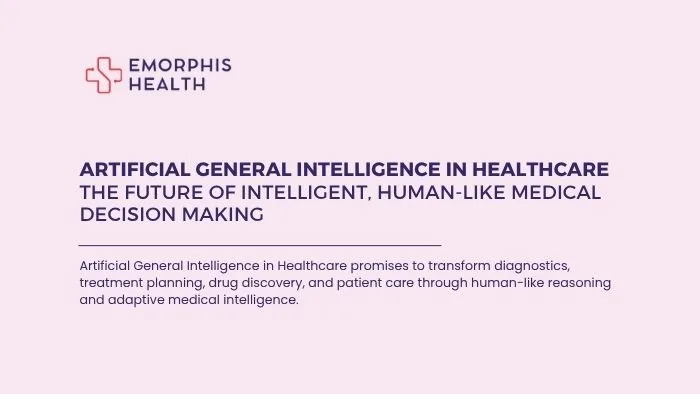
Unlike traditional artificial intelligence systems that are designed to perform specific tasks, Artificial General Intelligence (AGI) aims to replicate human-level reasoning, learning, problem-solving, and decision-making across multiple domains. The emergence of Artificial General Intelligence in Healthcare could fundamentally transform patient care, medical research, diagnostics, treatment planning, hospital operations, and healthcare accessibility.
As healthcare systems face increasing challenges related to rising costs, physician shortages, complex diseases, and growing patient expectations, Artificial General Intelligence in Healthcare offers the potential to solve some of the industry’s most pressing problems.
Understanding Artificial General Intelligence in Healthcare
To understand the significance of Artificial General Intelligence in Healthcare, it is important to distinguish AGI from traditional AI.
Most healthcare AI solutions today are examples of Narrow AI. These systems excel at specific tasks such as image recognition, predictive analytics, speech transcription, or patient monitoring. While effective, they cannot reason beyond their designated functions.
Artificial General Intelligence in Healthcare, on the other hand, would possess the ability to:
- Learn from diverse medical data sources
- Understand complex patient conditions
- Apply medical knowledge across specialties
- Adapt to new diseases and healthcare scenarios
- Make informed recommendations with minimal human intervention
- Continuously improve its knowledge base
An AGI-powered healthcare system could potentially function as a highly knowledgeable physician, researcher, administrator, and clinical assistant simultaneously.
Why Healthcare Needs Artificial General Intelligence
Healthcare generates enormous amounts of data every day. Medical records, laboratory results, imaging scans, genomic data, wearable device information, insurance claims, and clinical notes create a complex ecosystem of information.
Unfortunately, healthcare professionals often struggle to process this information efficiently.
This is where Artificial General Intelligence in Healthcare can create unprecedented value.
AGI systems could:
- Analyze millions of patient records instantly
- Detect hidden disease patterns
- Recommend personalized treatments
- Predict health risks before symptoms appear
- Accelerate drug discovery
- Support clinicians with evidence-based decisions
The ability of Artificial General Intelligence in Healthcare to synthesize information across multiple domains could significantly improve patient outcomes while reducing operational inefficiencies.
Transforming Medical Diagnostics
One of the most promising applications of Artificial General Intelligence in Healthcare is advanced diagnostics.
Current AI systems can identify specific abnormalities in medical images. However, they often operate in isolation and lack contextual understanding.
An AGI-powered diagnostic platform could evaluate:
- Medical imaging
- Patient history
- Genetic information
- Laboratory results
- Lifestyle data
- Environmental factors
By integrating all these variables, Artificial General Intelligence in Healthcare could provide highly accurate diagnostic recommendations.
For example, instead of identifying a tumor in a scan alone, AGI could assess the patient’s overall health profile, compare similar cases globally, and suggest the most effective diagnostic pathway.
Such capabilities could help reduce misdiagnosis rates and improve early disease detection.
Personalized Treatment Planning
Every patient responds differently to treatment. Factors such as genetics, lifestyle, age, environment, and medical history influence treatment outcomes.
Traditional healthcare often relies on generalized treatment protocols.
Artificial General Intelligence in Healthcare could enable truly personalized medicine by creating individualized treatment plans tailored to each patient’s unique profile.
AGI systems could:
- Analyze patient-specific risk factors
- Evaluate previous treatment responses
- Monitor real-time health changes
- Recommend dynamic treatment adjustments
- Predict potential complications
Through continuous learning and adaptation, Artificial General Intelligence in Healthcare could help clinicians deliver more precise and effective care.
Accelerating Drug Discovery and Development
Drug discovery is a costly and time-consuming process that often takes more than a decade.
One of the most transformative benefits of Artificial General Intelligence in Healthcare lies in pharmaceutical research.
AGI systems could:
- Analyze biological pathways
- Identify new therapeutic targets
- Simulate clinical trial outcomes
- Predict drug interactions
- Optimize molecular designs
By reducing research timelines and improving success rates, Artificial General Intelligence in Healthcare could accelerate the development of life-saving therapies for diseases that currently have limited treatment options.
This capability could revolutionize how pharmaceutical companies bring innovations to market.
Improving Clinical Decision Support
Physicians make countless decisions every day, often under significant time pressure.
Clinical decision support systems powered by Artificial General Intelligence in Healthcare could provide comprehensive assistance by:
- Reviewing patient records instantly
- Accessing the latest medical literature
- Evaluating treatment guidelines
- Identifying potential risks
- Suggesting evidence-based recommendations
Rather than replacing physicians, Artificial General Intelligence in Healthcare would function as a highly intelligent partner that enhances decision-making and reduces cognitive burden.
This collaboration between humans and AGI could lead to safer and more effective healthcare delivery.

Enhancing Remote Patient Monitoring
The growing adoption of wearable devices and connected health technologies has created new opportunities for continuous patient monitoring.
Artificial General Intelligence in Healthcare could transform remote patient management by analyzing data from:
- Smartwatches
- Wearable sensors
- Home monitoring devices
- Mobile health applications
AGI systems could detect subtle changes in patient conditions, predict health deterioration, and trigger proactive interventions.
This capability would be particularly valuable for managing chronic diseases such as diabetes, cardiovascular disorders, and respiratory conditions.
By enabling early intervention, Artificial General Intelligence in Healthcare could help reduce hospital admissions and improve patients’ quality of life.
Streamlining Healthcare Operations
Healthcare organizations face numerous operational challenges, including staffing shortages, administrative inefficiencies, and resource constraints.
Artificial General Intelligence in Healthcare could optimize operations through:
- Intelligent workforce planning
- Automated scheduling
- Resource allocation
- Supply chain management
- Revenue cycle optimization
- Administrative workflow automation
By improving efficiency across healthcare systems, AGI can reduce costs while enhancing patient experiences.
Hospitals and healthcare networks could achieve greater scalability and operational resilience through the implementation of Artificial General Intelligence in Healthcare solutions.
Supporting Medical Research
Medical researchers face the challenge of navigating an ever-growing volume of scientific literature and clinical data.
Artificial General Intelligence in Healthcare could significantly accelerate research efforts by:
- Reviewing millions of publications
- Identifying knowledge gaps
- Generating research hypotheses
- Designing experiments
- Analyzing clinical trial results
Researchers could leverage AGI to discover new insights that may otherwise remain hidden within massive datasets.
As a result, Artificial General Intelligence in Healthcare could become a powerful catalyst for scientific innovation.
Expanding Global Healthcare Access
Healthcare disparities continue to affect millions of people worldwide.
Many regions face shortages of qualified medical professionals and limited access to specialized care.
Artificial General Intelligence in Healthcare could help bridge these gaps by providing intelligent healthcare support in underserved communities.
Potential applications include:
- Virtual healthcare assistants
- Multilingual patient support
- Remote diagnostic services
- Automated clinical guidance
- Telehealth enhancement
Through scalable digital healthcare solutions, Artificial General Intelligence in Healthcare could contribute to more equitable healthcare access globally.

Challenges and Considerations
While the benefits are substantial, the adoption of Artificial General Intelligence in Healthcare also presents challenges.
Healthcare organizations must address:
- Data privacy and security
- Ethical AI governance
- Regulatory compliance
- Model transparency
- Bias mitigation
- Patient trust
Developing safe, reliable, and explainable AGI systems will require collaboration among healthcare providers, technology companies, regulators, and researchers.
Responsible implementation will be critical to realizing the full potential of Artificial General Intelligence in Healthcare.
Exploring Artificial General Intelligence in Healthcare Solutions with Emorphis Health
As healthcare organizations prepare for the next generation of intelligent healthcare systems, partnering with experienced technology experts becomes increasingly important.
Organizations looking to explore Artificial General Intelligence in Healthcare opportunities can benefit from the expertise of Emorphis Health. With extensive experience in healthcare technology, AI-driven healthcare platforms, digital health solutions, interoperability, remote patient monitoring, healthcare analytics, and intelligent automation, Emorphis Health helps healthcare providers and healthcare innovators build future-ready solutions.
Whether the goal is developing advanced clinical decision support systems, intelligent patient engagement platforms, AI-powered healthcare applications, or next-generation AGI-driven healthcare ecosystems, Emorphis Health experts can help organizations evaluate opportunities, design scalable architectures, and implement innovative healthcare solutions aligned with evolving industry needs.
The journey toward Artificial General Intelligence in Healthcare requires both technological expertise and deep healthcare domain knowledge, making strategic partnerships essential for long-term success.
Conclusion
The future of healthcare is becoming increasingly intelligent, connected, and personalized. Among emerging technologies, Artificial General Intelligence in Healthcare represents one of the most transformative advancements on the horizon.
From diagnostics and personalized medicine to drug discovery, clinical decision support, remote monitoring, operational optimization, and healthcare accessibility, Artificial General Intelligence in Healthcare has the potential to reshape every aspect of the healthcare ecosystem.
Although AGI remains an evolving field, healthcare organizations that begin exploring its possibilities today will be better positioned to lead tomorrow’s healthcare transformation. As technology continues to advance, Artificial General Intelligence in Healthcare may become a foundational pillar of a more efficient, proactive, and patient-centered healthcare system.
Further, find details on Scribe AI – The Future of Clinical Documentation and Intelligent Healthcare Workflows.