Overview
See Contents
- 1 Overview
- 2 Why AI in Pharma Manufacturing Company Is Critical in 2026
- 3 Core Transformation Areas Enabled by AI in a Pharma Manufacturing Company
- 4 Technical Architecture for AI in a Pharma Manufacturing Company
- 5 Compliance and Validation Considerations
- 6 Organizational Transformation Required
- 7 Conclusion: The Future of AI in Pharma Manufacturing Company Operations
The pharmaceutical industry is entering a decisive phase of digital maturity. As regulatory expectations tighten, batch complexity increases, and pressure for right-first-time manufacturing intensifies, AI in pharma manufacturing company operations is no longer experimental. In 2026, it is becoming foundational. For technical leaders in pharma, including plant heads, quality leaders, automation engineers, and digital transformation teams, the question is not whether to adopt AI, but how deeply it should be embedded into manufacturing systems, quality frameworks, and operational decision-making.
This article explores how a pharma manufacturing company can transform itself using AI in pharma manufacturing company ecosystems, with a focus on technical implementation, data architecture, compliance alignment, and manufacturing intelligence.

Why AI in Pharma Manufacturing Company Is Critical in 2026
Pharma manufacturing operates at the intersection of high variability, strict compliance, and zero tolerance for error. Traditional MES, SCADA, and QMS systems are deterministic by design. They record and control, but they do not reason.
AI in pharma manufacturing company environments introduces probabilistic intelligence into deterministic systems. This allows manufacturers to move from reactive quality management to predictive and prescriptive operations.
Key drivers accelerating AI adoption include:
- Increasing FDA and EMA scrutiny on data integrity and continuous process verification
- Demand for real-time release testing (RTRT)
- Rising cost of batch failures and deviations
- Workforce skill gaps and knowledge loss
- Scale-up challenges for biologics and personalized medicines
In 2026, AI is no longer a layer added on top of pharma IT. It is becoming a core decision engine across manufacturing, quality, and compliance.
Core Transformation Areas Enabled by AI in a Pharma Manufacturing Company
1. Intelligent Process Control and Predictive Manufacturing
One of the most impactful applications of AI in pharma manufacturing company operations is advanced process analytics. Machine learning models trained on historical batch data, PAT signals, and equipment telemetry can detect non-linear process drifts long before they breach control limits.
Key capabilities include:
- Multivariate statistical process control using ML instead of static SPC
- Soft sensors for critical quality attributes (CQAs)
- Predictive yield optimization
- Dynamic control of CPPs in continuous manufacturing
This shifts manufacturing from fixed setpoints to adaptive process optimization, while remaining within validated design spaces defined under QbD frameworks.
2. AI-Driven Quality Management and Deviation Reduction
Quality is the backbone of any pharma manufacturing company. AI in pharma manufacturing company quality systems enables a transition from document-heavy compliance to intelligence-driven quality assurance.
AI models can:
- Predict deviation likelihood based on batch conditions
- Classify root causes using historical deviation patterns
- Recommend CAPA actions based on effectiveness scores
- Detect data integrity anomalies across ALCOA+ principles
In 2026, AI-powered QMS platforms are increasingly integrated with MES and LIMS, enabling closed-loop quality management rather than siloed investigations.
3. Digital SOP Intelligence and Knowledge Systems
SOP adherence is a persistent challenge on the shop floor. Operators often struggle with version control, interpretation, and contextual application of procedures.
AI in pharma manufacturing company knowledge systems transforms static SOPs into dynamic, context-aware guidance engines. Using NLP and semantic search, AI can deliver:
- Step-specific SOP guidance during batch execution
- Role-based procedural instructions
- Multilingual operator assistance
- Automated SOP impact analysis during change control
This reduces human error, shortens training cycles, and improves audit readiness, while maintaining strict document control under 21 CFR Part 11 and Annex 11.
4. Predictive Maintenance and Asset Reliability Engineering
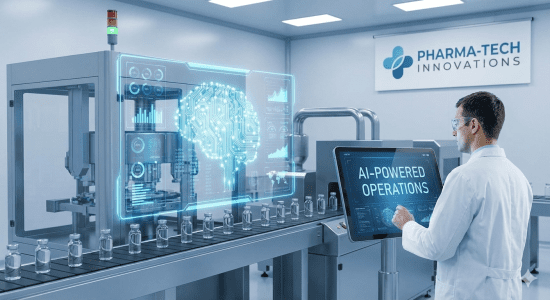
Equipment downtime directly impacts OEE, batch schedules, and compliance. Traditional preventive maintenance is time-based, not condition-based.
With AI in pharma manufacturing company asset management, sensor data from granulators, reactors, fillers, and HVAC systems can be analyzed using anomaly detection and time-series forecasting models.
Benefits include:
- Early failure detection for critical equipment
- Reduced unplanned downtime
- Optimized maintenance windows
- Extended asset lifecycle without compromising GMP
In 2026, AI-driven predictive maintenance is becoming a regulatory-friendly approach, as it improves control rather than introducing risk.
5. Supply Chain and Batch Genealogy Intelligence
Pharma supply chains are complex, regulated, and highly sensitive to disruptions. AI in pharma manufacturing company supply chain intelligence systems use predictive analytics to optimize material availability while ensuring traceability.
Applications include:
- AI-based demand forecasting for APIs and excipients
- Supplier risk scoring using quality and delivery data
- Batch genealogy analysis across multi-site operations
- AI-assisted recall impact assessment
This enables more resilient, transparent, and compliant supply chains aligned with serialization and traceability mandates.
Technical Architecture for AI in a Pharma Manufacturing Company
Implementing AI in a regulated manufacturing environment requires a robust and compliant architecture. In 2026, mature pharma organizations follow a layered approach:
- Data Layer: Historian, MES, LIMS, QMS, SCADA, IoT sensors
- Integration Layer: OPC-UA, ISA-95 compliant connectors, APIs
- AI Layer: ML models, NLP engines, anomaly detection pipelines
- Validation Layer: Model versioning, audit trails, explainability
- Application Layer: Dashboards, copilots, decision support tools
Explainable AI (XAI) is critical. Models must provide traceable reasoning to satisfy regulatory inspectors and quality reviewers.
Have a look at the details of the Accelerative AI Framework for Healthcare Solutions as well as the details of a Multimodal AI in Healthcare.
Compliance and Validation Considerations
A common misconception is that AI complicates compliance. In reality, AI in pharma manufacturing company environments can strengthen compliance if implemented correctly.
Key principles include:
- GAMP 5 aligned AI validation strategies
- Continuous model monitoring and re-validation
- Clear segregation of learning vs locked models
- Full auditability of AI-driven decisions
- Data integrity by design
Regulators in 2026 are increasingly open to AI, provided manufacturers demonstrate control, transparency, and risk-based validation.
Organizational Transformation Required
Technology alone does not transform a pharma manufacturing company. AI in pharma manufacturing company initiatives requires cross-functional alignment between IT, OT, QA, Manufacturing, and Regulatory Affairs.
Critical enablers include:
- AI literacy for quality and manufacturing teams
- Strong data governance frameworks
- Clear ownership of AI models
- Change management aligned with GMP culture
Organizations that treat AI as a core manufacturing capability rather than an IT experiment will lead the next decade of pharma production.
Conclusion: The Future of AI in Pharma Manufacturing Company Operations
By 2026, AI in pharma manufacturing company strategies will define competitive advantage. Companies that successfully embed AI into process control, quality systems, SOP intelligence, asset management, and supply chains will achieve higher compliance, lower cost of quality, and faster time to market.
Emorphis Health experts help pharma organizations implement AI in pharma manufacturing company solutions by combining deep expertise in regulated software engineering with hands-on manufacturing domain knowledge. Their teams design GMP-first AI architectures aligned with GAMP 5, 21 CFR Part 11, Annex 11, and ALCOA+ principles, ensuring AI models are explainable, auditable, and validation-ready from day one.
Emorphis engineers integrate AI seamlessly with MES, SCADA, LIMS, QMS, and historian systems using ISA-95 compliant frameworks, enabling real-time process intelligence, predictive quality analytics, and SOP intelligence without disrupting validated environments.
By focusing on industrial data contextualization, controlled model lifecycle management, and compliance-by-design, Emorphis enables pharma manufacturers to operationalize AI in pharma manufacturing company initiatives safely, scalably, and in line with regulatory expectations for 2026 and beyond.
For technical leaders in pharma, AI is no longer about automation. It is about intelligence, foresight, and controlled adaptability within a regulated environment. Those who architect AI with GMP, QbD, and data integrity at the core will set the standard for the next generation of pharmaceutical manufacturing.
Further, here are more contents you can follow for such a topic.
- The 2026 Pharma Audit Checklist, Navigating Complexity with Intelligence.
- Pharmaceutical Regulatory Compliance in 2026: A Practical Guide to Pharmaceutical Compliance in Manufacturing.
- When OEMs and Pharma Plants Think Together, How AI Is Redefining Operations Across the Pharmaceutical Manufacturing Floor.